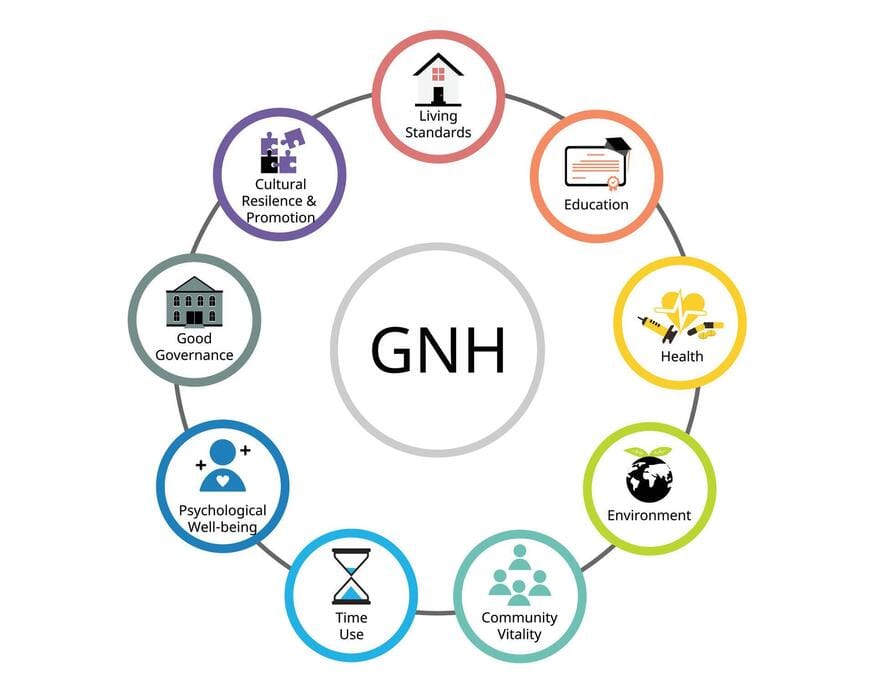
In Thimphu we had two conversations that, looking back, feel like two sides of the same question: what is happiness – and who will shape it in Bhutan in the future?
A visit to the GNH Centre Bhutan
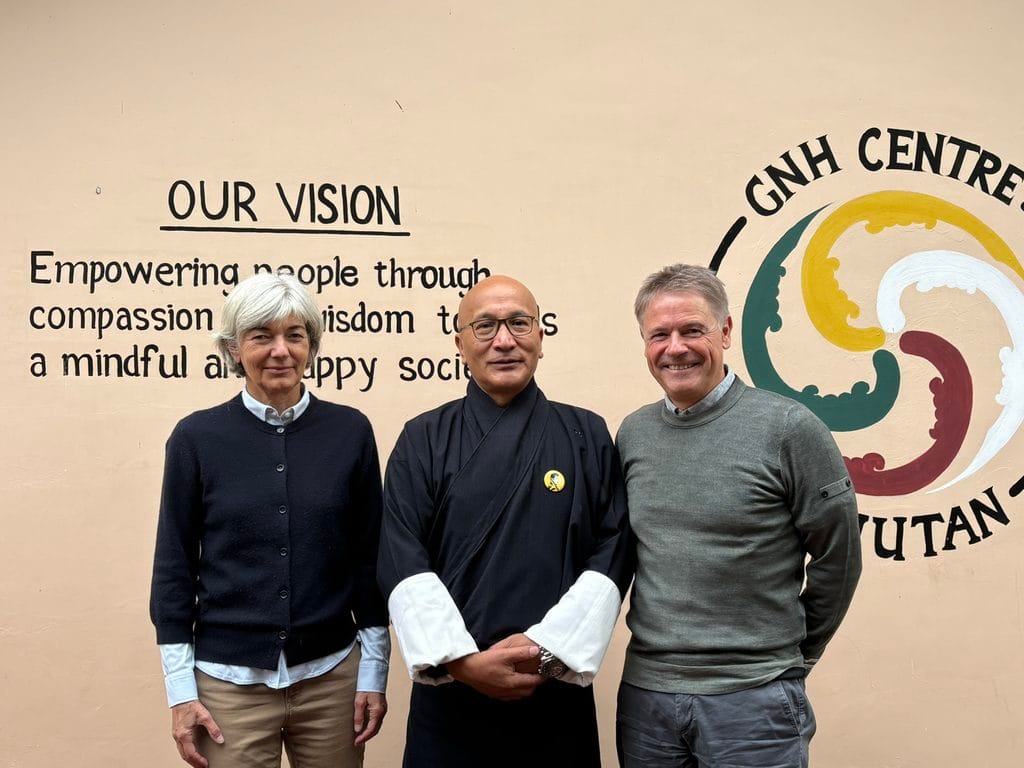
At the GNH Centre Bhutan, Lhatu Lhatu takes an hour to talk with us. He heads the Centre as Executive Director and previously served two terms as a Member of Bhutan’s Parliament. The Centre sees itself as a voice for Gross National Happiness – towards business, schools and civil society, and increasingly internationally.
One thought has stayed with us ever since: in Dzongkha (Bhutan’s national language), the term for Gross National Happiness carries two meanings, happiness and peace. Even the people the Fourth King asked, as he travelled the country on foot, what they wished for gave the same answer: peace and happiness, nothing else. As long as we have that, we are satisfied.
Lhatu Lhatu also speaks openly about what worries Bhutan. Many young people are leaving the country, above all for Australia; the Prime Minister calls it an existential threat. Lhatu Lhatu hopes that most of them will return after studying abroad and bring back what Bhutan needs.
Two young Karmas at the helm
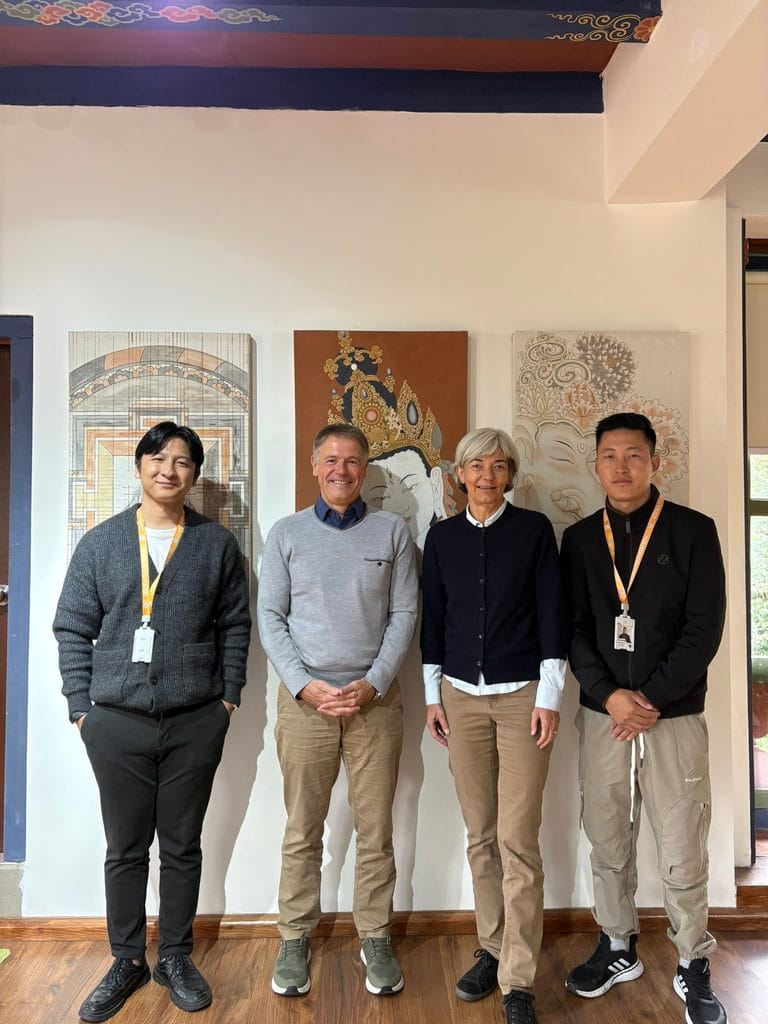
We see how Bhutan’s young generation takes on responsibility at the Loden Foundation. Since 1999 the foundation has supported education, culture and young entrepreneurs. It grew out of a single donation of fifty pounds. Today it is run by two young men who are both called Karma: Karma Losel Yangnyen, 28, leads the foundation, and his colleague Karma Tshering, 29, is in charge of administration.
It is no coincidence that such young people lead. In many offices, people aged roughly 30 to 42 are missing – they are in Australia. Those who stay take on responsibility early.
Titles are just titles, says Karma Losel Yangnyen. In the flat organisation, programme leads make their own decisions; his job is to help the others reach their goals. He holds one-on-ones every two weeks, and his key indicator is not performance but satisfaction. People who join Loden are not looking for big salaries but for impact. If people like that are not satisfied, the organisation is doing something wrong. He also speaks openly about his doubts, for instance whether new formats take time away from more experienced colleagues. Such doubts, he says, help him do better.
And the future? Both Karmas place their hopes in Gelephu Mindfulness City. The project is better than doing nothing, says Karma Losel Yangnyen – before, young people simply left. What convinced him is how the King presented the project himself: first the vision, then the steps and the why, openly and accessible to everyone. And perhaps Gelephu will show the world that GNH works not only in villages and forests, but in a city as well. His colleague Karma Tshering sees it above all as a chance for young people to stay in the country and work for Bhutan.
What connects the two conversations
Reading our notes again, we noticed that one word comes up in both conversations: satisfaction. For the people the Fourth King asked, it meant peace and happiness. At Loden, it is the key measure of good leadership. And what Lhatu Lhatu hopes for Bhutan’s youth, we met in the two Karmas: young people who take on responsibility and believe in their country’s future.
GNH is not a theory
What impressed us most in both conversations: in Bhutan, Gross National Happiness is not a theory written down in strategy papers. It runs through everyday life – in the state, in society and in organisations like these two.
At the GNH Centre, GNH is explained, taught and carried out into the world. When we ask whether the ministries still make their decisions by it, Lhatu Lhatu answers: it is DNA, because it came from the very top.
At Loden, by contrast, the nine domains are rarely mentioned explicitly as a guide for the organisation. Nobody has pinned them to the wall, says Karma Losel Yangnyen. And yet we find them everywhere: in the lending criteria, which only support businesses that are socially, environmentally and culturally responsible and that create jobs or keep their profits within the community. In the “Power Fridays” the younger team members asked for. In the plan to extend paternity leave beyond the ten days granted in the civil service. And in the question about satisfaction that Karma Losel Yangnyen asks every two weeks. The values are modelled – by the King, by the foundation’s founder – and carried on by the people.
What organisations can learn
Bhutan is a special place, with its own history and culture. What can be transferred is not the forms, but the questions behind them – wherever an organisation calls home. These are our first learnings:
Values work when they are lived. No mission statement replaces a role model. In Bhutan, GNH comes from the top and becomes visible in everyday life. Organisations can ask themselves: how would anyone recognise what matters to us – without reading a single poster?
Satisfaction is an early warning signal. When people who came for the impact become dissatisfied, something is wrong. Asking regularly about satisfaction, even before performance, shows early where discord is growing.
Impact is the measure. GNH is not a rejection of economic success, Lhatu Lhatu stresses. Businesses need to be economically viable, otherwise they can neither survive nor give. The question is at what cost. Loden turns this into clear criteria: a business must be viable, but it is supported for its impact.
Leadership is a service. At Loden, titles are just titles, and leading means helping others succeed. Lhatu Lhatu names humility, empathy and integrity – rather than pride, prejudice and ego – as the foundation of good leadership. Making room for doubt makes leadership more human, not weaker.
Trust young people with responsibility early. In Bhutan this is a necessity, because a generation is missing. The two Karmas show what becomes possible. In many countries, organisations face a generational shift. How much responsibility do we entrust to younger people – and how do we support them in it?
Small practices change a lot. Lhatu Lhatu recommends occasionally giving employees a Friday off; their commitment, he says, rises noticeably. At Loden there are the “Power Fridays”. Not every measure has to be big to make a difference.
We are curious which of these learnings will be confirmed in our next conversations – and which we will discard.
How much peace is there in the way we work together – and do we actually ask whether people are satisfied?