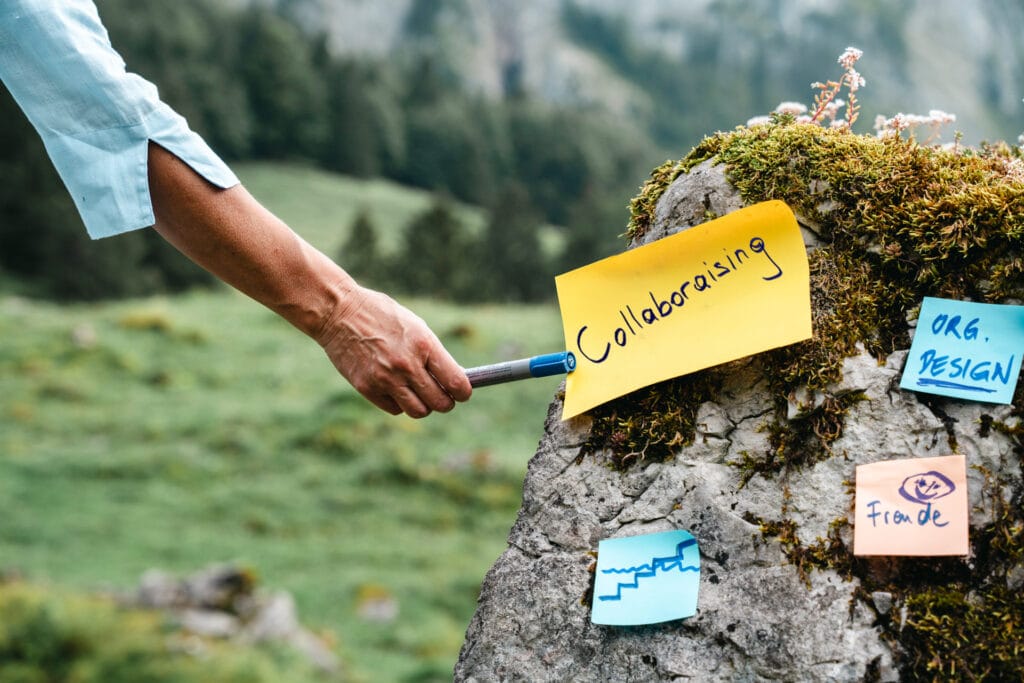
For weeks we had been gathering words. On sticky notes, on the backs of notepads, on a large sheet of paper that eventually covered the entire wall of our workspace. We were trying to name what we keep observing in the organisations we work with – that peculiar mixture of connection, development, and shared movement for which no existing term seemed sufficient. “Collaboration” felt too narrow, “organisational development” too technical, “transformation” too grand, “cultural change” too vague. Each term had its merit, and yet all of them missed the core of what we meant.
The wall filled up, then emptied again. Some words stood there for days before we took them down, others flew into the wastepaper basket within hours. At some point we realised that sitting in front of this wall wasn’t getting us anywhere, and we did what we often do when a thought has stalled: we set off. Out of the office, into nature, simply along the next path. When we walk, our thoughts are different. They no longer line up neatly one after the other but flow, connect, leave space between themselves. And somewhere between an uphill stretch and a bend in the path, one of us spoke the word out loud for the first time, and the other heard it, and in the same second both of us knew: this is it.
Collaboraising.
Two Movements in One Word
Collaboraising joins two movements that we have mostly thought of separately. Collaboration stands for the deliberate working together, for the shared act that arises when people contribute their perspectives, strengths, and responsibilities, instead of merely functioning side by side. Raising stands for the mutual lifting, for the process of learning and development in which no one moves forward alone but in which all those involved grow with one another.
When we speak of raising, we explicitly do not mean quantitative growth in the sense of higher, faster, further, but rather the lifting of quality: the quality of relationships, of awareness for the whole, of an organisation’s ability to grow beyond itself. We are speaking of a different kind of movement than the one we know from growth curves – a movement into depth and breadth, not only into height.
The word Collaboraising joins these two movements because they condition one another. Genuine working together lifts those who take part, and only people who are taken seriously in their own development are capable of committing themselves to a shared something larger. At its core, Collaboraising describes the deliberate cultivation of what Michael Tomasello calls our “we-capacity”: that characteristically human ability to set aside short-term self-interest in favour of shared goals, and through this to bring forth institutions, cultures, and organisations that no individual could ever have created alone.
Friction as a Sign of Life
Collaboraising lives from difference and disagreement. It needs irritation, diversity, and the willingness to have one’s own convictions examined, because only where perspectives meet and rub against one another does the kind of movement arise from which something new can grow. An organisation in which everyone thinks the same is essentially an echo chamber and not a living community.
This is why it needs an honest foundation, so that collaboration does not fall into the trap of groupthink – that familiar phenomenon in which everything divergent is quietly filtered out until the group drifts off into a world of its own apparent agreement, where it then often makes decisions that no individual member would ever make on their own. Real collaboration tolerates friction, because it knows that friction is a sign of involvement and not of disturbance.
Many organisations still treat collaboration as a tool to be deployed when things get stuck, when silos cause friction and a workshop on interfaces is meant to bring the solution, or when innovation is needed and “creative spaces” are suddenly set up. Our experience shows something different. Where collaboration truly succeeds, the very logic of value creation changes, and performance arises not despite, but through relationship and dialogue. Martin Buber put it well: “Through the Thou, a person becomes I.” Only in resonance with others do we unfold our full potential, and the same is true for the organisations in which we move.
More Than a New Label
When we speak of Collaboraising Organisations®, we don’t mean idealised images or perfect systems, but organisations that are alive, that remain capable of learning, and that have understood that lasting impact arises where development is not imposed but shaped together. For us, collaboration is not a soft topic but the actual infrastructure of an organisation, comparable to the root system of a forest – something one does not see, and yet without which nothing could grow.
A new word alone changes no organisation, we know that. But it can open a door, behind which a different way of looking becomes possible, and sometimes it is precisely this different way of looking that makes the difference between yet another efficiency programme and a real development. Perhaps this is the actual task of language: not to describe reality as it is, but to make visible what could come into being if we took it seriously.
To see what Collaboraising means in practice for the way organisations work together, visit Collaboraising Organisations.