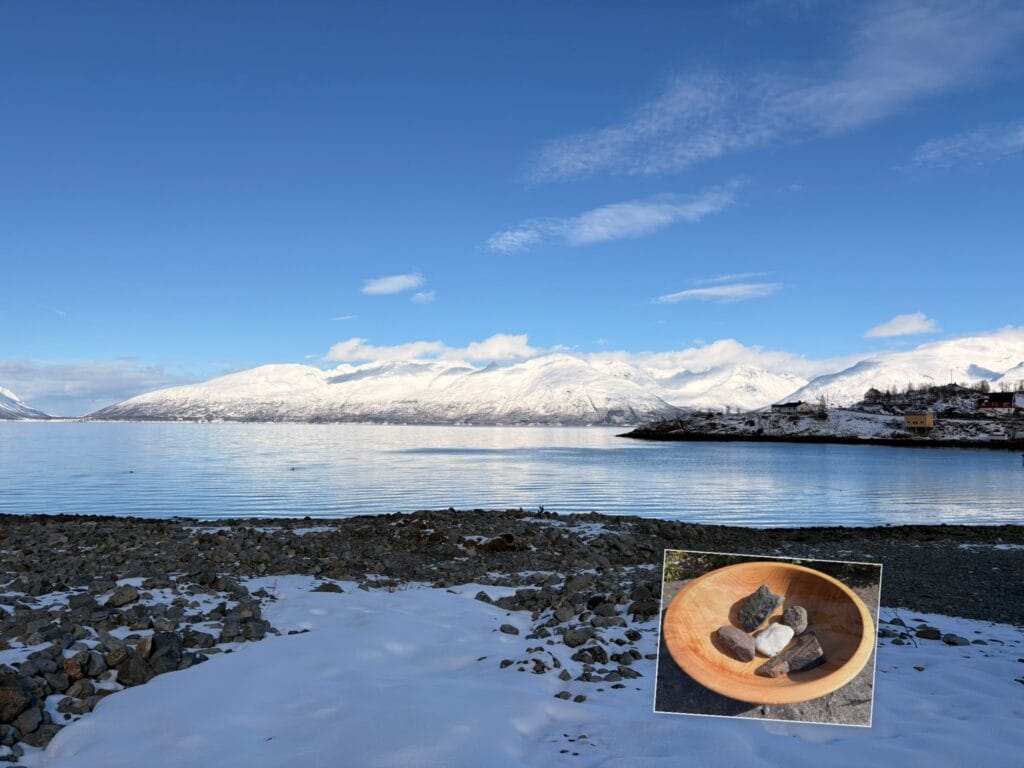
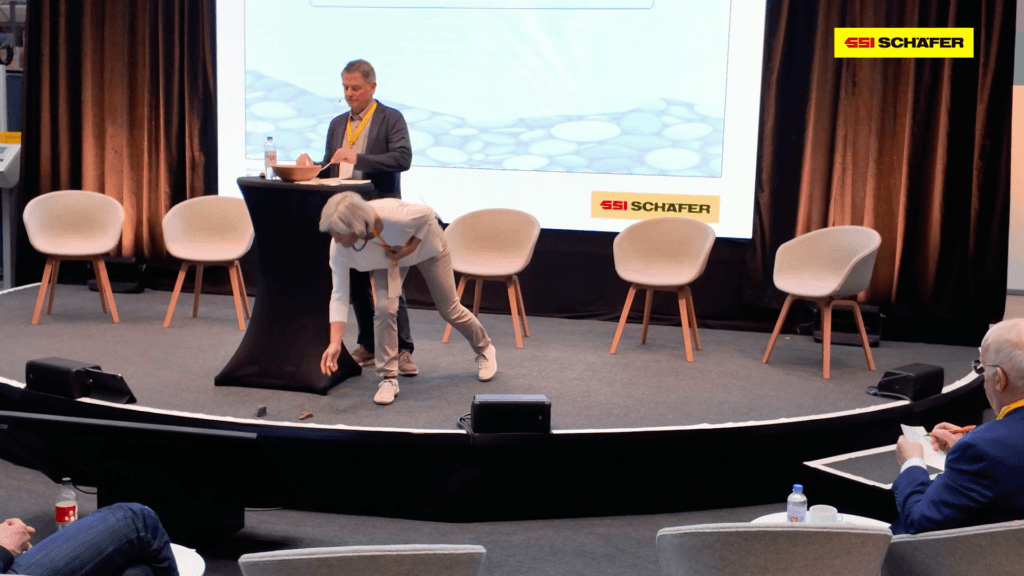
A few days ago, we stood in an industrial hall with thirty thought leaders and shapers of the future. In front of us, on a small table, lay a wooden bowl with five stones we had gathered only days before in Norway, beyond the Arctic Circle. Behind us lay two dense half-days of AGORA, the format Dr. Bernhard von Mutius convenes once a year, an afternoon and a morning filled with conversations about people, robotics, AI, and about the question of where the future of our industry actually lies. On the afternoon of the second day, when the circle had already shared much together, our turn came.
No one had quite expected the title of our contribution: „Stabilisers in AI disruption – what holds when everything vibrates?” You are warmly invited to read along and think with us about why we believe this question cannot be postponed.
The wrong reaction: operational frenzy
You probably know this from your own organisation. AI is accelerating, the pace is rising, and the reflex is almost everywhere the same – more speed, more tools, more projects, more control, more of everything we already know. We call this the pressure cooker of operational frenzy: AI projects are set up, pilots launched, workshops organised, and much of it is well-intentioned, yet remains on the surface of what is actually moving beneath.
Some time ago we came very close to an iceberg in Greenland, in a kayak, circling it carefully and being warned repeatedly not to come too close, when suddenly the iceberg turned over before our eyes: the peak we had just been admiring sank into the icy sea, and the previously hidden underside faced the sun for the first time. It was an image that has stayed with us ever since, because it shows something we keep encountering in organisations as well.
What is visible – the processes, the structures, the tools – is only the peak, and the actual dynamics lie beneath, in attitudes, in images of power, in relationships. AI does not merely amplify what is already there but also shifts the conditions under which structures can hold, so that even structures functioning well today may come under pressure tomorrow. Nora Dietrich, an expert on mental health in the workplace, speaks in this context of organisational burnout – organisations exhausting themselves under the weight of their own initiatives – and we would add that AI initiatives without organisational maturity are the surest path there.
Five stones, five stabilisers
We devoted the opening of our contribution at AGORA to the metaphor of our stones. We had only just gathered them at the Arctic Circle, in a place where the effects of climate change are very strongly felt: glaciers are melting, coastlines are shifting, the land itself is transforming before our eyes. And yet these stones are what they have always been – stone, carrying change within themselves without being dissolved by it. This is precisely what we mean when we speak of stabilisers: not the prevention of change, but the capacity to carry it.
We took the stones out of the bowl one by one and placed them into the room – one for each stabiliser, one after the other, visible in the middle, where there had been nothing before. Perhaps, as you read, you might place your own stones in your mind in a spot where there had been nothing before.
Stabiliser 1: Distributed responsibility
AI decentralises knowledge, and from this it follows almost necessarily that responsibility, too, must be decentralised – not as a nice concept, but very concretely as decisions made where competence and context meet. We work with the image of „dial, not switch”, because this is not a binary choice between human and machine, between centralised and decentralised, but a matter of situational adjustment: some decisions the AI makes better, some the human does, and most emerge best when both work together in clearly distributed roles.
Responsibility in this understanding is not simply handed out, it is negotiated, and it is portioned in the size that someone can actually carry, because what is too large produces overwhelm, and what is too small produces mere executors – and neither of these will serve us well in the AI era.
Stabiliser 2: Dialogue and collective intelligence
AI can help us find good questions, sometimes even brilliant ones, but it cannot sense which question, in this room, with these people, at this moment, creates movement, and which merely creates busyness. The greater danger of AI, then, seems to us not that it will take our work away, but that we will forget how to talk to each other – that we will trust the algorithm more than our colleague and ignore what is left unsaid, because the data, after all, appears to be right.
In every organisation there are sentences no one contradicts, not because everyone agrees, but because silence is more comfortable; and silence in organisations is never abstention, but a form of confirmation. The temptation in the AI era is now that we will increasingly hide behind data instead of saying what is uncomfortable in the room, and it is precisely this temptation that must be consciously resisted.
Stabiliser 3: Conscious (un)learning
For us, this is the central stabiliser of the AI era, and it has two sides that belong together. One side is learning: building new capabilities, and doing so for everyone, not only for the IT department, because in the AI era learning time must naturally be working time. The other side is harder and remains largely unaddressed in many organisations – unlearning, the conscious letting go of old assumptions that no longer hold but that no one dares to name.
We mean, very concretely, those sentences that exist side by side in our organisations every day, without anyone daring to point out the contradiction:
„Collaboration is our most important asset” – yet we still reward individual performance.
„We want a learning culture” – yet anyone who makes a mistake faces a career problem.
„We are built on trust” – yet every decision requires three sign-offs.
These are not small inconsistencies but systemic contradictions, and AI makes them mercilessly visible, because every AI initiative will fail precisely where the system speaks a different language than the strategy. Rik Vera, a Belgian futurist, puts it sharply when he observes that our boardrooms are calibrated for answers and not for questions, that KPIs do not measure uncertainty and shareholders do not applaud unlearning – and that, precisely for this reason, we outsource our curiosity.
Stabiliser 4: Radical kindness
That we speak of kindness in a business context may come as a surprise, and we want to clear up a misunderstanding from the outset: we do not mean niceness, nor harmony at any cost, but a conscious choice for a respectful, attentive way of dealing with one another – especially under pressure, especially in difference, especially in conflict. Kindness in this sense is not a feeling that arrives when the situation is favourable, but a stance that one chooses precisely when the situation does not invite it.
In times of technological overload, people need psychological safety, because no one who is afraid will learn, no one who is afraid will experiment, and people who are afraid will hide behind routines instead of opening themselves to what is new. Kindness, therefore, is not a soft topic but the social lubricant that prevents AI change from turning into resistance, and emotional contagion works in both directions: fear of AI spreads just as readily as curiosity, and as the person responsible we have a say in what we sow.
Stabiliser 5: The art of balance
In our garden we have set up a slackline, and anyone who stands on it once learns very quickly that balance does not come from standing still but from constant, fine corrections – and whoever overcorrects amplifies the swing and falls. The same is true with AI: there is the adventure trap, betting everything on AI without a foundation, and there is the safety trap, ignoring AI in the hope that it will pass, and the art lies in between, in a stability that serves as a springboard, because those who do not know whether the ground will hold do not jump.
What strikes us as particularly uncomfortable in the AI era is the suggestion of maximum efficiency – every position filled once, every process trimmed to the bone, every buffer optimised away – which works as long as everything goes according to plan, and the moment something unforeseen happens, and it always does, the reserves are gone. Redundancy, paradoxical as it sounds, is therefore not waste but the precondition for people to dare to jump into what is new in the first place.
What Europe has – and what you can do now
At the end of our talk we pointed to the five stones in the centre of the room: visible, tangible, holding, while outside everything was vibrating.
Europe has something Silicon Valley does not have, and it is worth saying without false modesty: we have a deep organisational substance, a culture of relationships that has grown over generations, and an entrepreneurship that does not look for a quick exit but for the next generation. This is not a lag but a foundation – and it is precisely this foundation that we need in order to integrate AI into our organisations in a way that is responsible, human, and sustainable.
Three invitations we would like to leave with you, the same ones with which we closed our talk.
The first is a question you can ask in your organisation, openly and together: what do we need to unlearn so that AI can actually become useful, and which old assumptions are holding us back?
The second is an investment decision: invest in human infrastructure, not as a counterweight to technology, but as a precondition for it. Because trust, dialogue, and distributed responsibility are not costs, but the investment in a true competitive advantage.
And the third is a stance: open up, without fear, with curiosity, with a sense of new beginnings.
Our five stones we left in the room after the talk, and they are now somewhere out in the world. The question we placed at the end, however, belongs to you as well:
If AI took over thirty percent of the tasks in your organisation tomorrow – what would you do with the freed energy? And: would your organisation even allow it?
Tell us what you think. We look forward to the conversation.
With thanks to Dr. Bernhard von Mutius and the AGORA circle for two days full of substance, and to Peter Edelmann for the hospitality.