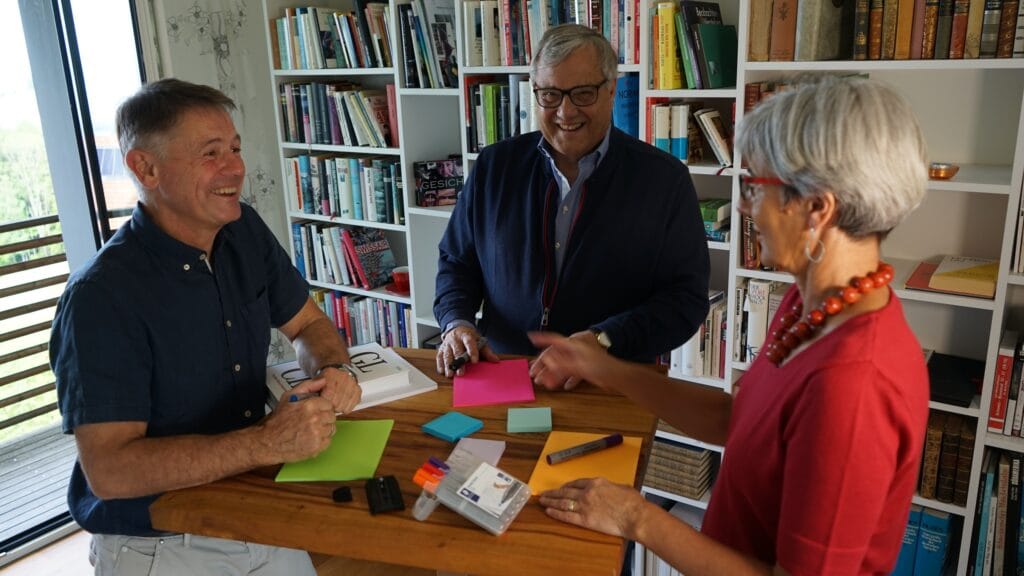
Many people can debate. We do it every day – in meetings, over lunch tables, in endless threads. We bring arguments, weigh them up, persuade or give way. Usually there is a result at the end: one of us had the better argument, the other conceded. And yet a quiet feeling sometimes remains that we have talked past one another.
Dialogue is something else. Both have their place – the art lies in recognising which one a moment calls for.
A debate wants to persuade. At its core it is a contest of arguments – and often that is exactly right. When a decision is due, when positions need clarifying, when time is short, you need this contest, from which a direction emerges. What a debate rarely does, though, is change the person conducting it. You tend to come out of it as you went in – confirmed or defeated, convinced or outvoted.
A dialogue wants to understand. Its place is where the point is not to decide quickly, but to recognise together something that no one saw alone before. It asks a different question. Not „How do I refute you?” but „What do you see that I don’t?” That sounds simple, almost harmless. It is not. Because this question demands something that has become rare in our conversations: the willingness to come out of a conversation changed. Not confirmed. Changed.
What Buber meant
A hundred years ago, Martin Buber captured this in a distinction that still holds today. He spoke of two basic stances with which we meet others. In the first – he called it the I‑It – I regard the other as an object: someone I inform, persuade, work on, slot into my own purposes. In the second – the I‑Thou – I meet them as a counterpart. As someone who has something to tell me that I do not already know.
Real encounter, Buber held, arises only in the second case. Not when I treat the other as a means, but when I trust that they see a world to which I have no access. This is not a technique or a communication trick. It is a stance – and it cannot be faked. People sense very precisely whether they are being persuaded or genuinely listened to.
For organisations this is an uncomfortable insight. We have built entire conversation formats designed to reach results efficiently. That is good and necessary. But where every conversation becomes a debate, something is lost: the ability to recognise together something that no one knew alone beforehand. Yet that is the very core of what we call collective capability – the capacity of a group to see and carry more than the sum of its individuals. And this capability grows less in the contest of arguments than in thinking together.
Why dialogue is uncomfortable
If dialogue is so powerful – why is it so rare? Perhaps because it asks something that comes hard: to allow an open outcome. Whoever truly listens gives up control over how a conversation ends. They might, in the end, come to see their own position differently. That is uncomfortable – and perhaps that is precisely why we so often prefer to debate.
There is also this: dialogue takes time, and it cannot be forced. You can sit people down and announce an „open conversation” – and still none emerges, because everyone senses the decision was made long ago. Dialogue is not a meeting format you schedule. It is a state that is allowed to arise when the conditions are right: when no one need fear that openness will be used against them, and when those involved genuinely believe the outcome is still open.
That is harder than debating. And it is more effective. Because the insights that emerge in dialogue carry further – precisely because they were not imposed but found together. People defend what was forced upon them only as long as they must. What they have helped to recognise themselves, they carry of their own accord.
Why we are travelling to Bhutan now
This question – how real dialogue succeeds and what it makes possible – we are taking at its word in the coming weeks. Soon Urs and I will spend three weeks in Bhutan. In a country that has been asking an uncomfortable question for half a century: what if we measured progress not by growth alone, but by the wellbeing of people? Bhutan turned this into a national goal – Gross National Happiness – and has been wrestling ever since with what it actually means in daily life. Just now, as many young people are leaving the country, that question is anything but abstract.
We are not interested in the postcard version. We are interested in the conversations: with researchers who try to measure the happiness of a nation, with monks and teachers, with farmers and conservationists, with students weighing whether to emigrate, and with journalists who view it all critically. People who live with this big question and its contradictions. We are not travelling to bring back answers. We are travelling to listen – and to find out what we see when we look through other eyes.
Dialogue begins with listening. So that is where we start.
Stay curious.