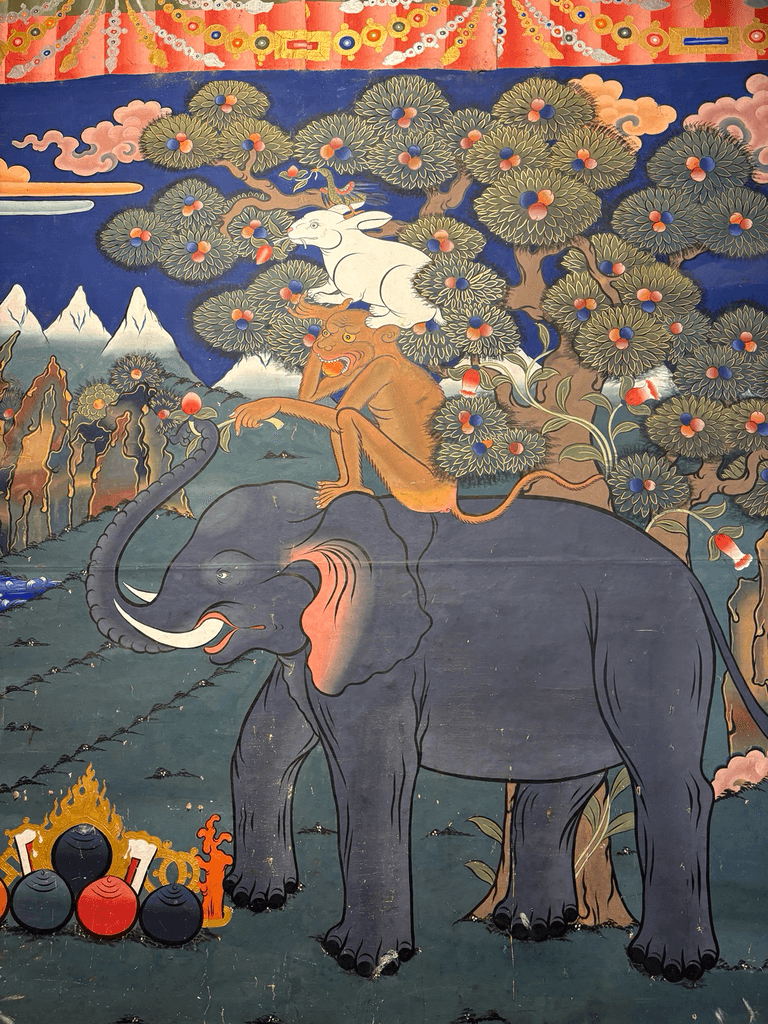
At the entrance of Rinpung Dzong in Paro, Karma shows us a mural you meet again and again across Bhutan: the “Four Harmonious Friends” (Thuenpa Puen Zhi) – an elephant, a monkey, a hare and a bird, stacked one above the other at a fruit tree. The story comes from the Jataka tales of the Buddha’s former lives; the bird brings the seed, the others help it grow and keep it safe, and once the tree bears fruit, they can reach it only together. For Karma, the image is above all an expression of teamwork.
Traditionally its meaning reaches further still: it stands for harmony, interdependence and cooperation – and, at the heart of the tale, for respect for age: the animals rank themselves by who has known the tree longest, and the younger carries the elder. You find the motif in monasteries and dzongs, in public buildings and in private homes. What strikes us is how vividly a value is made visible here – and how persistently the image, present everywhere, keeps that meaning in view.
For us, this image became surprisingly familiar. Karma calls it teamwork; what stays with us is the shared responsibility – different abilities meshing together, and a result none could achieve alone. That is our bridge from a Bhutanese tale to the question that runs through our work: how does something durable emerge when responsibility is shared?