‘How can one practise tolerance without enemies, and how can one practise giving without beggars?’ (Buddhist wisdom). After our stimulating conversation at the Loden Foundation, we now face around five hours of bend after bend, uphill and downhill. Plenty of time to discuss, reflect and think things through. In the car we listen to Prime Minister Tshering Tobgay’s speech to the 81st session of the United Nations General Assembly, which has just taken place. ‘I stand before you today not as Prime Minister, but as a salesman’ – and with that he makes the case for the flagship project ‘Gelephu Mindfulness City’. A project intended to uphold Bhutan’s principles (Gross National Happiness) while enabling the economic development the country needs – and with it, prospects for its young people. All this on an area five times the size of Singapore, meant to bring together the world’s most important learnings and practices.
Mindfulness is the central theme of every conversation – it is even in the city’s name. We are here to learn – we say that in every conversation, too. But what does that actually mean? How well do we manage not just to move intellectually through our programme, but to genuinely take the message of mindfulness on board, personally and emotionally? We know that we have to be flexible about organisational matters, and we are good at it. We have been teaching ‘flexibility’ for decades and know only too well that, as we get older, it needs conscious practice – but then, we are the experts, aren’t we? Or are we?
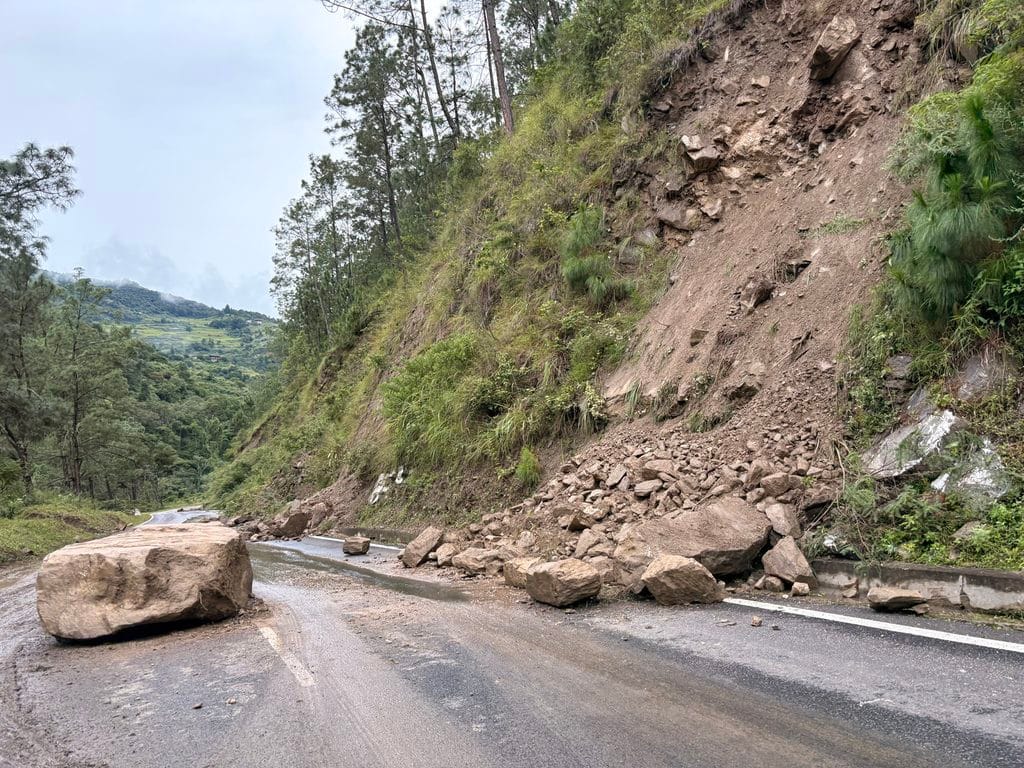
Again and again the road narrows – here lie heaps of rubble and rocks, there another stretch of road has broken away – never mind, we can handle that. After all, we are sitting in a safe car and our driver weaves his way through while we follow the UN speech. But hang on – how absurd is this, really? It dawns on us that, in our minds, we are sitting in a conference hall in New York, while what is really happening passes us by, (as yet) without touching us emotionally. Well, that is hardly mindful.
Slowly but surely, we too are drawn into the reality of roads turned to mud by days of rain. Realising how drivers are overtaking on blind bends with barely any acceleration to spare, we are wide awake. The Phobjikha Valley, promisingly introduced as ‘Little Switzerland and home of the black-necked cranes’, emerges in patches from the drifting fog. All the power lines here have been laid underground to protect the rare cranes. That is progressive and mindful at the same time. The power itself, however, keeps failing – most recently for the past three days. Outside, the temperature has dropped to barely 10°C. Weary, we drive past every hotel we furtively spot on Google Maps and wonder where today is going to take us.
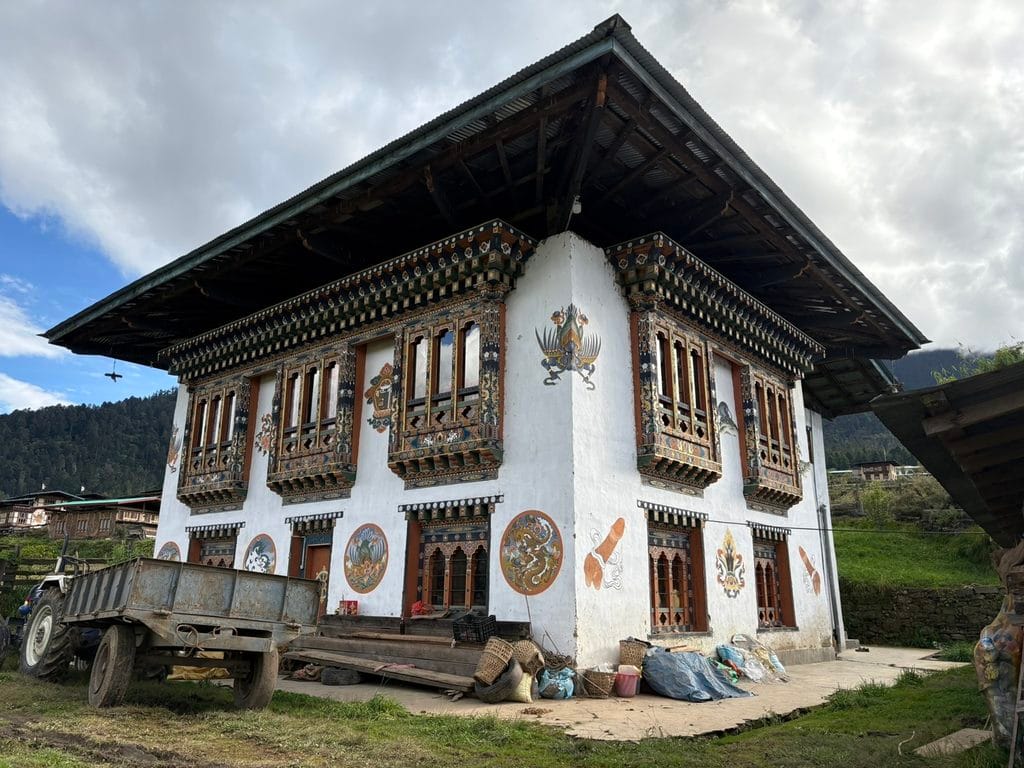
The architecture of many of the houses is impressive, and sure enough we turn into the steep, muddy driveway of one of them. The gate is closed, but no matter – even after several attempts, the car gets stuck in the mud before we reach it, so we continue on foot. The house could not look less lived-in. Phallic images guard the entrance – unfamiliar to us, but in Bhutan common protective symbols against evil spirits and misfortune. Sadly, they are no help with our door lock: in the end it takes six people and more than half an hour before we can enter the cold house – farm stay accommodation! The situation is awkward for everyone, and yet everyone remains respectful.
Our room is clean; the little fan heater is switched on at once and the single mattresses are pushed together. The basic shower drips, the buckets placed underneath are overflowing – and where is our flexibility now? We pull ourselves together – of course we are flexible, after all – take care not to let our disappointment show, retreat to our room for a moment to catch our breath and pull on an extra jacket. Four nights of this lie ahead of us. Even though the people are very kind, and two hours later we sit down on the floor mats in a warm communal room to eat, flexibility simply isn’t working very well for us today. If someone had told us, we could have prepared ourselves – as it is, everything comes completely out of the blue. Or should we not have trusted blindly, and asked instead … should have, would have?
Everyone is glued to their phones, the screen is playing cat-fail videos from YouTube – and we are no better: with little motivation and a weak internet connection, we try to get some writing done. After the second crash, and with cold feet, that is the end of that too. We curl up on the hard mattresses – our backs are already protesting at the thought of the whole night ahead, and the cinema in our heads starts rolling. After all, we have hours of tossing and turning to consider how things should go from here. A farm stay experience is all well and good, but four nights? And of course the question of cost versus benefit crosses our minds, too. Complain? Stay? Change our travel plans? Or find the right attitude after all? Each of us has our own late-night film showing, and with little sleep, autogenic training and a change of mindset, by morning we have both worked through the inner process to arrive at clarity and a positive attitude.
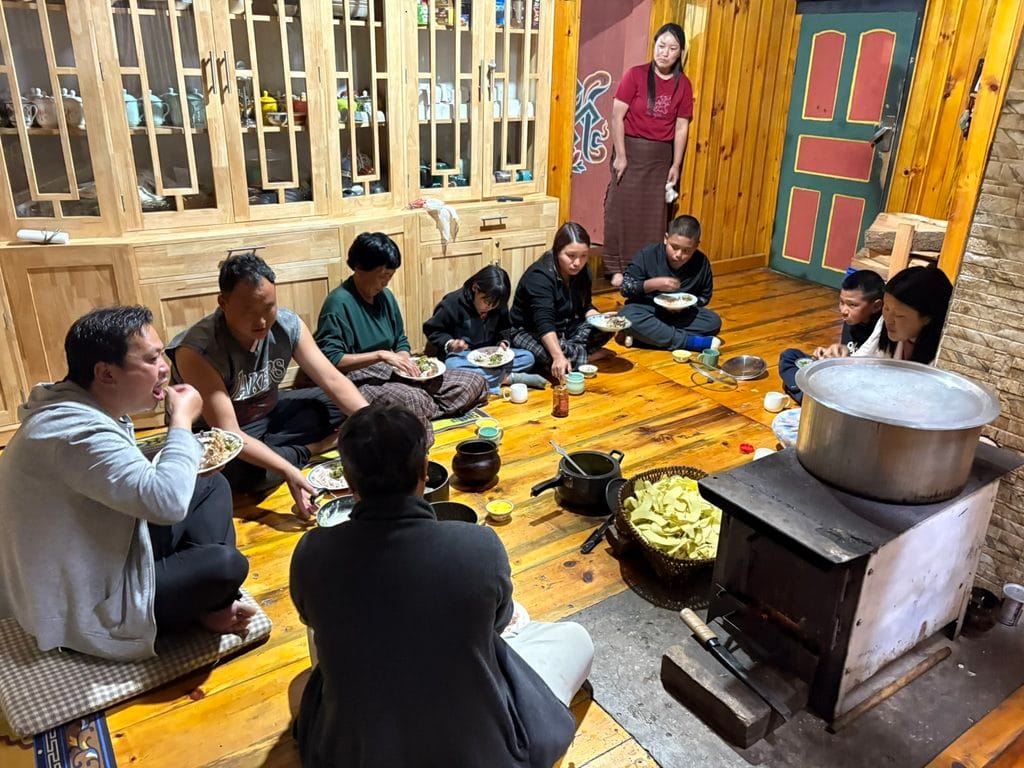
And so we manage to start the day cheerfully and optimistically, gratefully accepting and returning the host family’s warm-hearted efforts. On the organisational side, we calmly and specifically name what we are missing and what we need. We are able to fix the shower ourselves with a couple of simple adjustments. We agree on two nights, and from then on everything takes a positive turn. So our years of flexibility training have paid off after all.
Once again we have experienced, very vividly, that mindfulness is a process and means inner work, time and again. A dripping shower and the puddle surrounding the toilet became our little practice in composure. For organisations, this means that flexibility is not proven in the seminar room, but where expectations go unspoken and are suddenly not met. Perhaps just the right grounding for our next conversation – with the monk Dorji Lopen Ugyen Sonam in the Gangtey Goenpa monastery.
How do we deal with expectations that no one has voiced – in ourselves and in the way we work together?