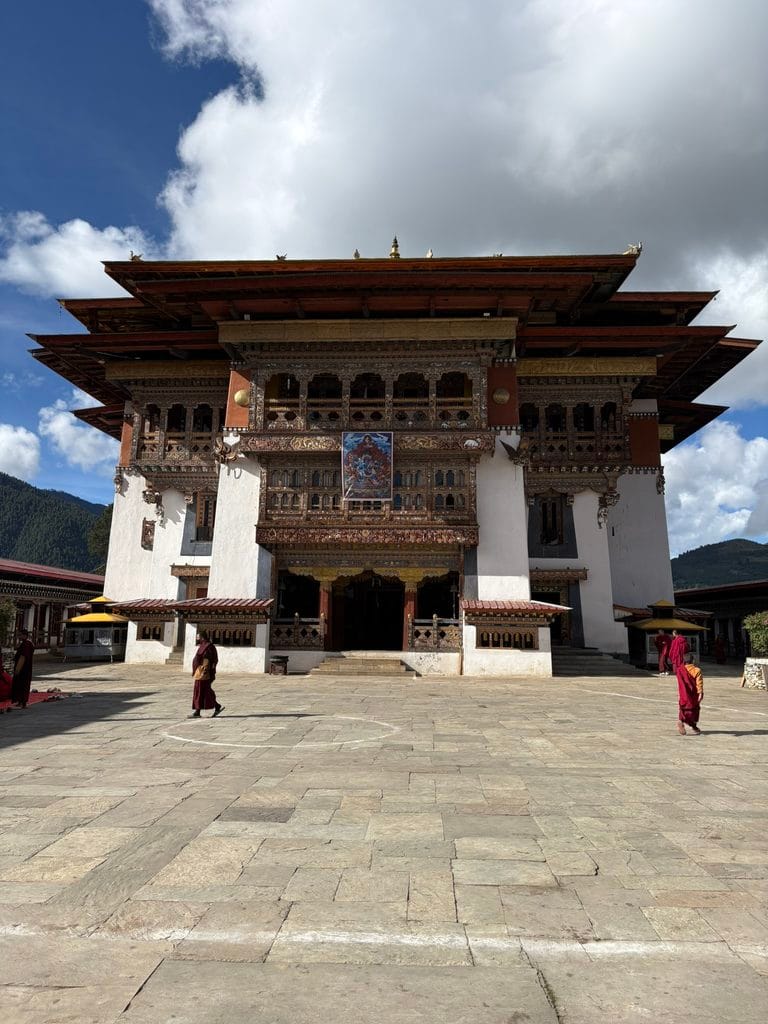
We follow Karma with anticipation as he searches the temple itself for our contact and eventually approaches a young monk. The monk nods and immediately begins to set up a small platform and lay out floor mats in front of it. Slowly it dawns on us that our conversation is going to take place in the middle of the temple. Here and there, guides are explaining the space to their guests, and over the next hour we keep catching curious, furtive glances. Then Dorji Lopen Ugyen Sonam comes towards us with a warm smile, takes his seat and, with an inviting gesture, shows us to our places on the mats. It is without doubt the most remarkable ‘meeting room’ of all our conversations so far. If we’d read this scene in a novel, we would have thought it was made up.
The day before, we had marvelled at the festival in the courtyard of Gangtey Goenpa and watched the dancers stride out of the temple. Now we are sitting inside it ourselves, drinking tea and delighted to see our host savouring the gifts we brought him as we talk: Mozartkugeln and Appenzeller Biberli. He speaks Dzongkha, Karma translates into English, and so what we relate here is a paraphrase rather than his exact words.
Letting go at the core
His first words concern our journey. That we decided to come to Bhutan for our studies is no coincidence, he says, but the expression of a karmic connection. You do not need to know exactly what you are looking for in order to be on a good path.
He then leads us straight to the essence of Buddhism and, without our having asked, gives us his answer to our questions about expectations and flexibility. Everything in life changes. Suffering begins where we cling to what is impermanent and try to hold on to it. Liberation comes when we manage to stop clinging to fleeting pleasures and accept the natural flow of change. Whoever understands this sees the people who suffer and struggle for their successes, and feels compassion for them, for all beings, animals included. From this inner freedom from expectations, he explains, a kind and patient attitude grows. You perceive other people and their concerns more clearly, negative energies disappear, and above all you feel your own strength and a deep sense of happiness.
He describes in very concrete terms what this attitude looks like in everyday life. Every morning, before the monks unlock the door and go out, they first think of others, so that they begin the day with exactly this mindset. All the good we do for others, in thought, word and deed, contributes to our own happiness.
The same framework for all
From here, we delve into life in the monastery. There is no age limit for entering; anyone can join of their own free will at any time. From then on, the same conditions apply to everyone. Whether a small boy or an older monk, all eat what everyone eats, pray when everyone prays and follow the same daily rhythm. The only distinction lies in their education, which is tailored to each individual’s starting point and abilities. The young monks do not return to their parents; the older monks look after them.
When we ask how business and Buddhism go together, he answers with ethics: understanding what is good and what is bad, no corruption, no stealing. This attitude, he says, is passed on by parents at home and by teachers at school.
GNH, Gelephu and our book
The monk stands fully behind Gross National Happiness and Gelephu Mindfulness City. Both, he says, are initiatives of the King, and he regards the Fourth King, who founded GNH, as an emanation of the Buddha of Compassion. These projects help the people and the country; they reflect values that are deeply rooted in families, and so happiness will multiply. Gelephu will succeed, he says, because it carries Buddhism and GNH along with it.
He then wants to know how we will talk about GNH and Gelephu once we are back home. We tell him about our book, about the parallels we see, and that our conversations in Bhutan have above all confirmed our thinking and added subtle nuances to it.
After asking whether we will come back to Bhutan, he leaves us with a personal message: Write your book without expectations, neither of money nor of fame. Let it find its own way, and when obstacles arise, overcome them. Then it will reach those it can help. When we explain the motivation behind our book, he says there is nothing greater than that. And with this, the conversation comes full circle.
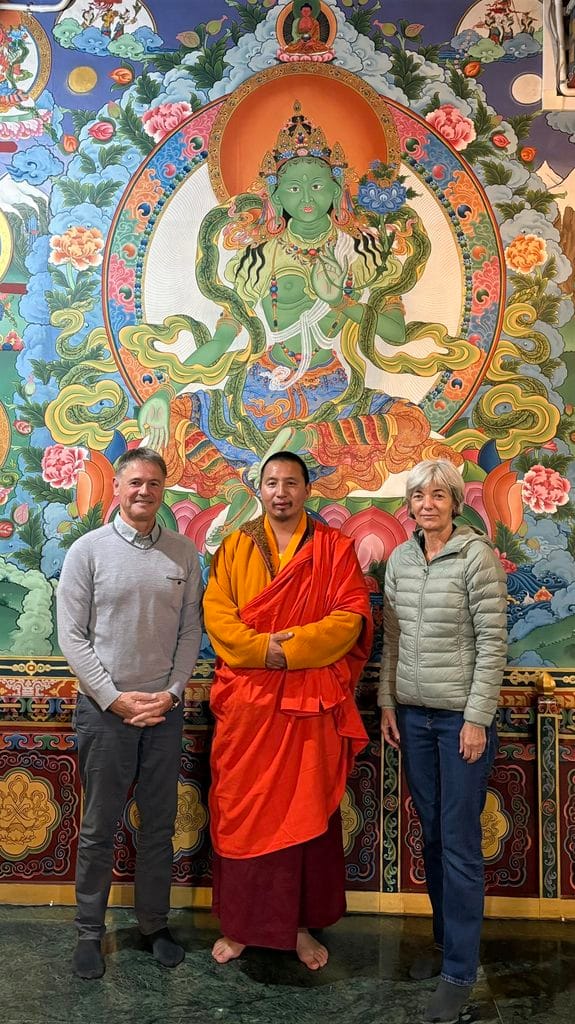
Finally, he surprises us by suggesting that we take a photo with him in the temple. Something that is normally not permitted thus becomes a lovely gesture from our host for the road ahead.
What organisations can learn from this
A monastery is not an organisation like any other, and much of what we heard is deeply rooted in Buddhist belief. What can be transferred is not the teachings themselves, but the questions they raise. These are our learnings from this conversation:
It is not striving that is the problem, but clinging. Goals and ambition are part of every organisation. Difficulties arise where we cling to growth, status or a particular outcome. Where does striving turn into greed for us, and how would we notice?
Staying open to what emerges. How much clarity about goals does change need? Too narrow a picture of the outcome can prevent something better from emerging. Openness does not mean arbitrariness, but the willingness to let go of one’s own picture when the path demands it.
The intention before the door. The monks think of others before they open the door. With what intention do we begin the working day, go into a meeting, enter a difficult conversation? Leadership begins before the first action.
Thinking, speaking and acting in harmony. What the monk describes as thought, word and deed, we call integrity, one of the three qualities of good leadership that Lhatu Lhatu at the GNH Centre also highlighted. A simple touchstone for organisations: do our values, our mission statement, our attitude and the way we put them into practice fit together?
The same framework, different guidance. In the monastery, the same conditions apply to everyone, but guidance is tailored to each person’s stage of development, and the experienced take responsibility for the younger ones. While an entire generation is missing in many Bhutanese offices, here the chain is intact. How consciously do we guide the younger ones in our organisations, and who feels responsible for doing so?
Values grow in everyday life. The attitude the monk speaks of is passed on at home and at school, not through guiding principles on paper. This confirms what we experienced at the Loden Foundation: values take shape through role models, in everyday interaction and in the way we welcome new people into our midst.
With what intention do we open the door each morning – and what are we still holding on to, when it is long past time to let go?