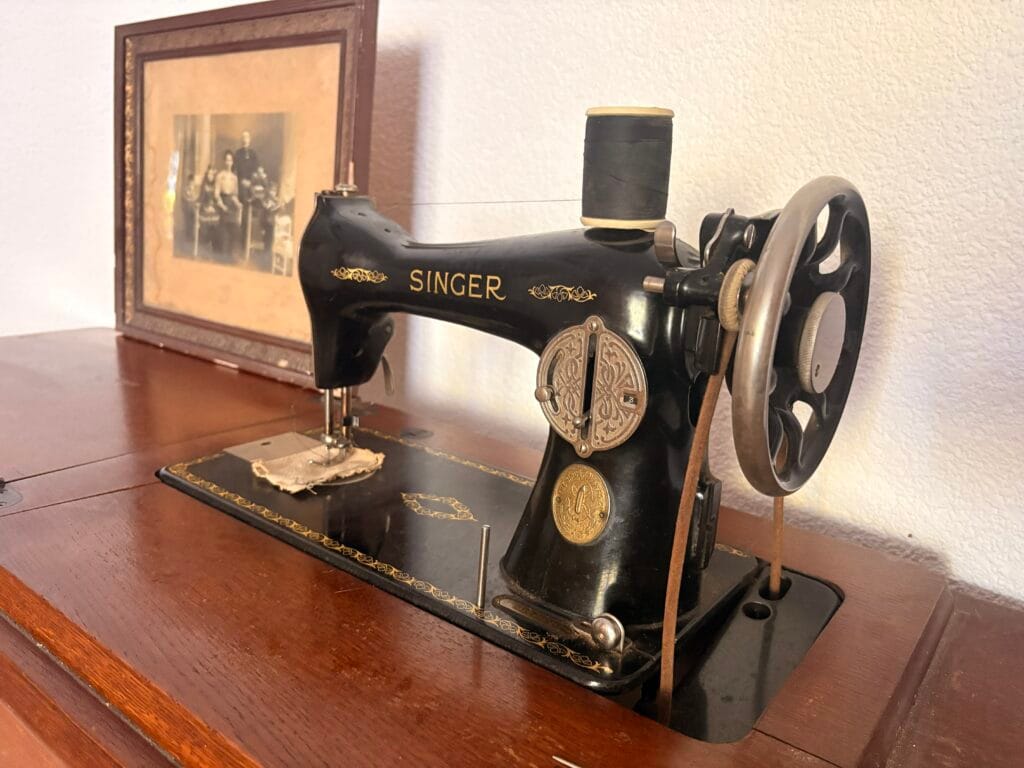
There is a sewing machine in my living room. It belonged to my grandmother. Black lacquer, gold ornamentation, a cast-iron pedal you work with your foot. No electricity, no display, no Bluetooth. When I walk past, I sometimes touch the flywheel and turn it. The machine runs. After all these years, it still does.
Next to it stands a photograph. My grandfather as a boy, his hand resting casually on a child’s chair, lined up with his parents and siblings for the photographer. Stiff collars, serious looks, a world that feels far away today. Whenever I look at the two of them together – the sewing machine and the photograph – I am reminded how much has changed in two or three generations. And at the same time: how much of the old still carries us.
In our work, we like to use an exercise that opens exactly this double view. A small exercise that makes the participants and us pause every single time.
The exercise
We invite you to think about your grandparents. Imagine how they lived, worked and decided when they were the same age that you are now. What values were taken for granted? What was self-evident? What place did work hold, and what place did family? How was responsibility taken on, how was everyday life organised, how was the future imagined?
At first, it goes quiet. The participants have to remember, sort things out, sometimes pause to think about what they actually know and what they are filling in. And then it gets very lively. Stories come up, images, anecdotes. Someone talks about their grandmother on the farm, where work and family across the generations were treated as one and the same thing, and where she helped out every day as a matter of course well into old age. Someone else mentions their grandfather, who grew old in a profession his granddaughter could no longer practise – because it no longer exists in that form. Someone remembers the matter-of-factness with which their grandparents lived in a village, in a faith, in a political order that could not be questioned.
And suddenly something becomes tangible that we know but keep forgetting:
Change is not the exception. Change is the normal state of things.
What often feels like a threatening acceleration today – the AI that is turning everything upside down, new ways of working, securities dissolving in front of us – is, at heart, the continuation of a development that has been running for generations. Our grandparents lived through it. Their grandparents too. What changes is the pace. What stays is the fact that much of what surrounds us is in motion.
And then the second question
When the images are still resonating, we ask a second question. One that often weighs more heavily than the first:
How much have organisations actually changed along with us?
This is where the room turns thoughtful. Because the honest answer is usually: less than we think.
While society, technology and life choices have developed at breath-taking speed, many companies are still organised internally according to logics from another era. Structures, images of leadership, decision-making mechanisms feel surprisingly familiar. Almost as if they had politely acknowledged social change – but never really let it in.
We carry smartphones in our pockets that our grandparents would have considered magic. We work with people we have never met in person. We live in family constellations that would have been unthinkable fifty years ago. But the organisational charts that frame our working day often still look the way they did back then. The assumption that thinking happens at the top and execution at the bottom sits deep. The idea that responsibility belongs to a position rather than to a task is still the standard. The notion that change can be planned at the top and rolled out downwards shapes countless transformation programmes.
And yet the world has long become a different one.
What the sewing machine tells us
Back to the machine at home. It still works. It is solidly built, honestly engineered, every part has its purpose. If I wanted to hem something today, I could use it. But no one would dream of running a tailor’s shop with this machine. Not because it is bad. But because the demands have changed – the fabrics, the volumes, the speed, the competitive logic, the lives of the people who wear the clothes.
That is often how I feel about the organisations I work with. They are not badly built. Much of what we today describe as ‘outdated’ was, in its time, clever, sensible, even progressive. Hierarchical structures, clear job descriptions, linear career paths – all of that had good reasons. It fitted a world in which tasks were repeatable, knowledge was scarce and predictability was a value in itself.
But the world in which those structures emerged no longer exists in that form. Just as my sewing machine belongs to a different time.
And this is the decisive point: it is not about devaluing what came before. The machine is not wrong because it is old. It is beautiful, it works, it tells a story. But it is not the tool for what lies ahead. This very transition – from ‘this was right’ to ‘this no longer fits’ – is a recurring theme. It hurts because it demands honesty, without writing off the past. It is not a reckoning. It is maturing.
What the exercise sets in motion
When we run the grandparent exercise in a workshop, the point is not to stir up nostalgia or romanticise the past. The point is to force a shift in perspective that is almost impossible in everyday life.
In our day-to-day, we are so deeply woven into our own assumptions that we no longer see them. We take our way of working to be normal, our structures to be given, our beliefs to be reality. Only when we look back two or three generations do we see: what feels normal to us is not timeless. It is the normality of our era. What feels self-evident today was unthinkable sixty years ago. What feels unthinkable today might be self-evident in thirty years.
This insight has a double effect. It makes us humble – we are not the end point of history. And it makes us courageous – if so much was possible, much is still possible today. Organisations that want to develop need both. Humility, so as not to overstate their own story. Courage, so as not to get stuck in it.
In his post on AGORA 2026, Urs described the deliberate practice of unlearning as perhaps the most important stabiliser of our time. The grandparent exercise is, at heart, a small tool for exactly that. It makes visible what we carry with us without realising it. And that is the precondition for choosing, consciously, what to keep and what to let go.
Speaking it out
If you have read this far, the exercise has, in a way, already happened. The images were there, the comparison too, the quiet sense that the old forms often no longer fit.
What is missing now is not the next method. What is missing is speaking it out.
A new form is needed. And it does not emerge on its own. It needs people with the courage to name what is obvious – even when the answer is not yet ready.