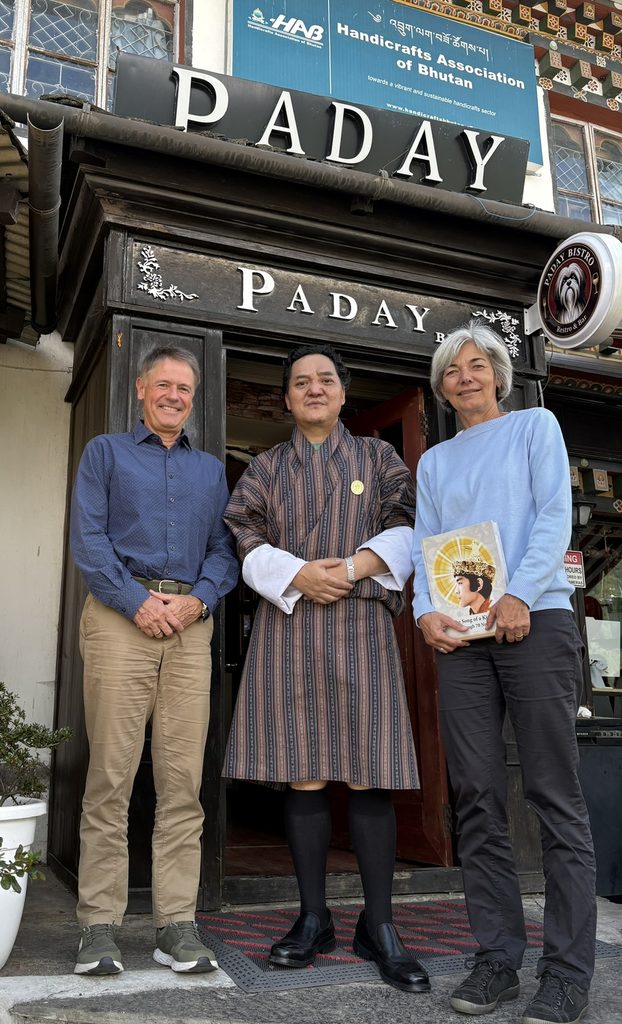
We invited Ugyen Tenzin to lunch at the restaurant of Sangay Khandu, our host in Thimphu, who has ties to both Austria and Switzerland. There is red rice, chicken and various vegetables, with chilli for our guest – far too hot for us. There is no set phrase for “enjoy your meal” in Dzongkha, says Ugyen Tenzin: “when it comes to meals, we are very serious.” He heads Business Bhutan, a weekly business newspaper with 21 staff. Before that he was a civil servant, studied public policy in Canberra, lived in Australia for four years and is, as he puts it himself, one of the returnees.
Values that guide
We want to know whether one can write freely in Bhutan. There are no restrictions, he says, but there are self-imposed ones, rooted in upbringing and culture and in the fact that the country is so small that everybody knows everyone, and whoever you write about may well be a relative. So are rules needed at all, we ask, if values rule instead? He gently corrects us: not ruling – guiding.
How open he remains shows in a question that has been on our minds since we arrived. Every visitor to Bhutan pays a fee of 100 dollars a day, intended to protect the country from mass tourism. We understand the intention well, but it largely excludes young travellers. Ugyen Tenzin does not have to think long: the fee is too high. Many guests from Asia stay only three nights anyway, Bhutan becomes a transit stop, and hardly anyone stays for two weeks. Then comes an observation that makes perfect sense to us: even after two weeks we have not yet seen the real Bhutan, because we have only been in the west. Protecting and opening up are not opposites here, but a balance that has to be struck again and again.
A judge washing dishes
Why do so many young people leave the country? He answers without hesitation: because of money. There is work in Bhutan, but it is poorly paid, and prices are rising. Abroad, many do odd jobs: here you might be a judge; in Australia you wash dishes. Actually, everyone wants to come back, because their family is here. His great hope is Gelephu Mindfulness City, where the first civil servants are already earning three times what they did before, and from where impulses are to spread to the east and south of the country over the next two decades. Will foreign investors come too? He sees no reason why not, but much will depend on who comes first.
The state is financing Gelephu partly through Bitcoin. Bhutan mines it with hydropower, fully green, and sees no contradiction in that: even if there is some harm, Ugyen Tenzin says, it is very small compared with the yield. The country is carbon negative and has to use what sets it apart: its nature, its mountains, its water.
When people are missing
As the greatest challenge he names what we had expected, and know from New Zealand or Finland, for example: the low population density. Just under 800,000 people live in a country almost the same size as Switzerland; many families have only one or two children, and some young people no longer want to marry at all. In India you can make a living from a coffee stall because there are more than enough people; in Bhutan almost every house has a shop, but too few customers. The villages are emptying, and that raises a question he asks openly: what kind of development do you bring to a village with only two or three houses and ten people left? The state now supports families financially when they have a third child.
What organisations need
What do Bhutan’s organisations need most? More courage, he says, and repeats it several times: they should be willing to take risks and become more creative and innovative. That is not happening enough at the moment, because around nine out of ten young people want to join the civil service. Good leadership is needed not only at the top of the country but across the whole economy; you cannot leave everything to the ministries. He sees the key in education: a system that worked twenty years ago no longer fits today, and there needs to be more critical discussion in the classroom. When we remark that there is only a fine line between critical thinking and respect, he nods: “We are not awakened ones.” Walking the middle path is the greatest challenge, and so far they have managed it.
Our conversation also makes it clear that, alongside courage, an understanding of business and entrepreneurship is often missing: entrepreneurial thinking that is grounded in one’s own values rather than drifting away from them.
We think of the lecturer at Royal Thimphu College who, when we asked his students questions, respectfully turned away – a gesture that gave them room to speak for themselves. Perhaps this is exactly how courage begins: with spaces where dissent has its place without respect being lost.
Seventy notes for a king
And then there is the gift with which Ugyen Tenzin had surprised us right at the start, after we had handed him our small presents: his own book, “The Song of a King – Through 70 Notes”. In seventy moments it tells the life of the Fourth King, who turned seventy last year and from whom the idea of Gross National Happiness originates. Because there were hardly any sources, Ugyen Tenzin went as far as libraries in India for his research. In the foreword, Princess Sonam Dechan Wangchuck expresses the wish that the younger generation may see in the King’s life the power of selfless leadership. On the first page he wrote for us: “Three Nations, One Vision”.
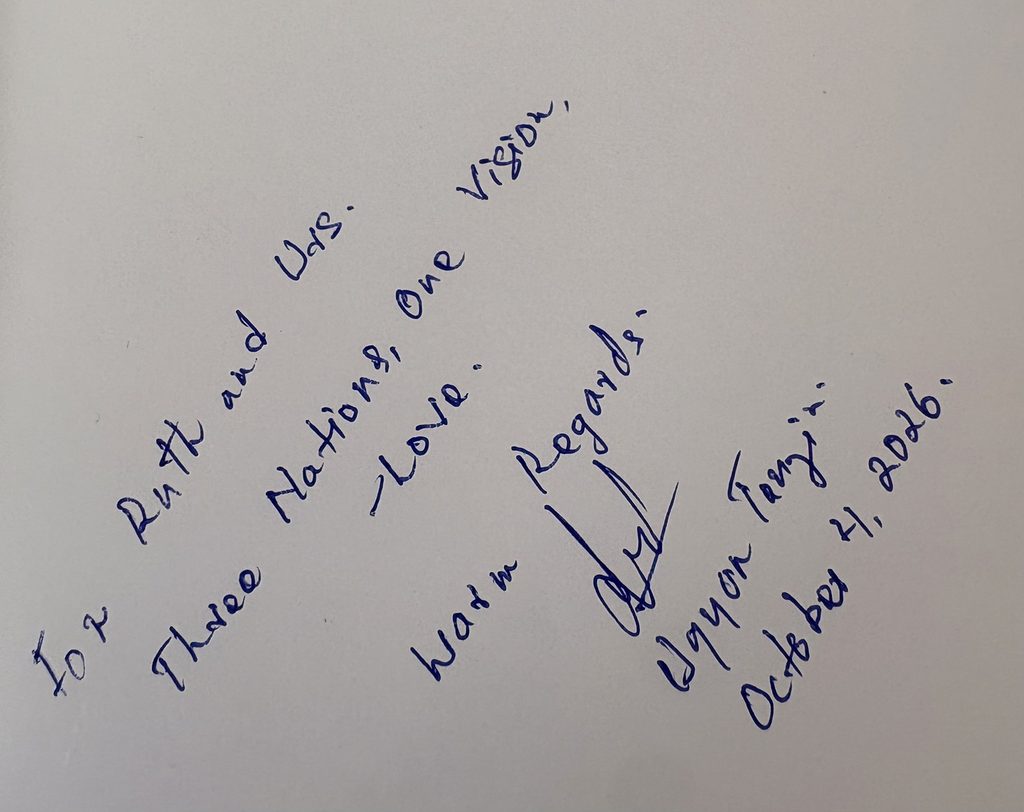
Right at the end he turns the tables and asks us whether we are satisfied with our work here in Bhutan, with all the conversations. We say yes, very much. We take the question home with us, because perhaps it is the simplest way of asking about happiness.
How much courage do our organisations allow – and how do we find the middle path between dissent and respect?