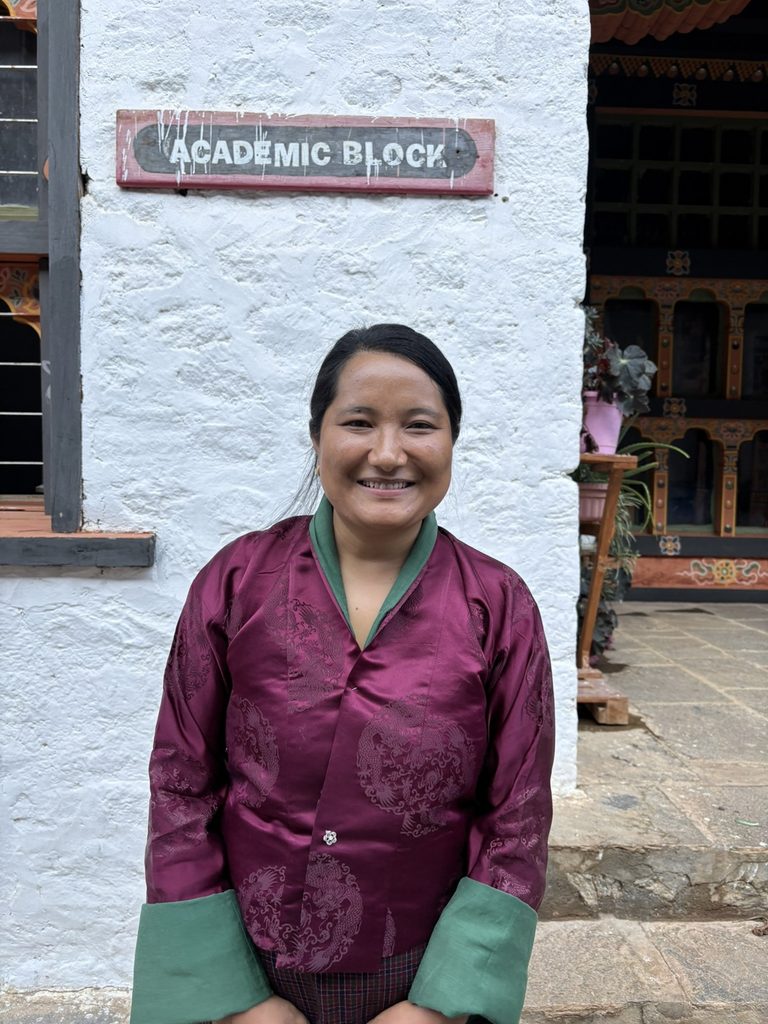
Only three days separate the two conversations. The first takes place at the College of Natural Resources in Lobesa with lecturer Serki Wangmo. The second takes place in Thimphu with Khina Maya, Pema Kumari, Lesh Kumari and Sonam Ugyen, who study Environmental Management at Royal Thimphu College, and with their lecturer Tshewang Dorji. Looking back, it feels as if we worked on the same question twice: once from the perspective of those who teach, and once from the perspective of those about to set out into working life. What must be protected so that something good can last, and where must we move so that it does not become rigid?
How much can a country carry?
Serki Wangmo has taught at the College of Natural Resources in Lobesa since 2015, in the Department of Sustainable Development. Her subjects include ecotourism and community-based resource management. As we talked with her about tourism and development, a term came up that has stayed with us ever since: carrying capacity. Bhutan is small, its ecosystem fragile, and the country has a limit to what it can bear. So it is about looking beyond the financial dimension and protecting nature and the value system as well. People do not want to dilute GNH, happiness and well-being.
That carrying capacity is about more than nature became clear when she talked about her degree programme. External examiners had recommended a stronger focus on the environment. The department pushes back, because sustainable development also includes the economy and society, and deliberately seeks a balance, even though it lacks lecturers in economics. An advertised post was left vacant rather than filled with people the committee did not consider suitable. That, too, is a way of taking your own carrying capacity seriously: you would rather live with a gap than dilute what makes you who you are.
A friendly space for learning
What moved us most was how naturally Serki Wangmo spoke about the atmosphere in her classes. Teaching has to be friendly, she said. Otherwise the quieter students would not answer or take part. That is why her students may send her questions on WhatsApp. She sets up forums on the learning platform and regularly asks for feedback on what she could do better. Students are at the centre: they explore topics themselves, present, discuss and help each other, and the lecturers learn from them too. Assessment is still individual, partly through peer feedback, and anyone who fails a module gets a second chance.
In organisations we call this psychological safety. Serki Wangmo puts it more simply: people take part when they don’t have to be afraid. We told her how surprised we were that even a couple outside their house spontaneously talk about Gross National Happiness. Her answer: GNH was not imposed, it grew naturally. The idea came from the King, but it is lived, taught and anchored in decisions by many.
The elders first
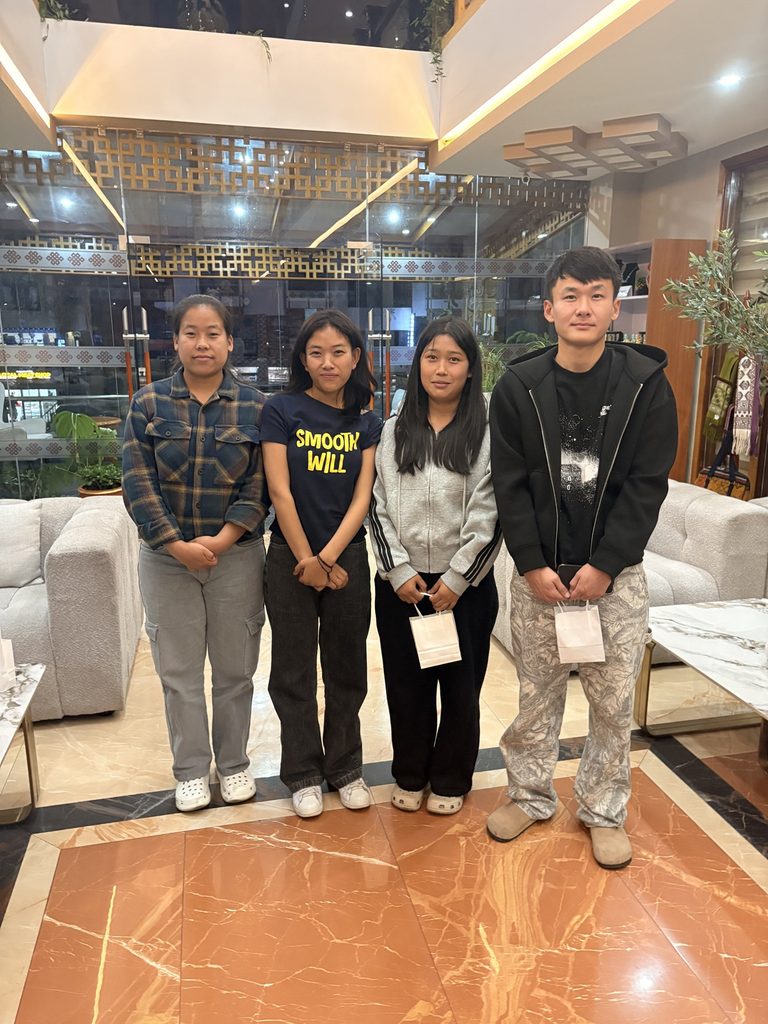
Three days later we sit down in Thimphu with the four students and their lecturer Tshewang Dorji. All four are in their final year. Before we start, there is tea, rolls filled with vegetables and a chilli sauce that is definitely too hot for us. The eldest are served first. It is a form of respect, the four explain, one they also live at home with their families.
We ask what happiness means to them. Their answers: good days with family and friends, being able to do what you love, feeling alive. One student says happiness means fulfilling her responsibility towards her parents, giving back and being grateful. “We are born with GNH,” says another. At the end of our conversation comes a sentence whose honesty impressed us: “We understand maybe 50% of GNH.”
Family also has a say in big decisions. Siblings or a father helped choose what to study, only one of the four chose alone, and all of them still live with their parents. Even so, we had the impression that for this generation, respecting one’s elders does not necessarily mean spending a whole life under the same roof as one’s parents.
Security first, and hope for Gelephu
After graduating, all four look towards Gelephu, where the Gelephu Mindfulness City is taking shape. They hope for opportunities for young people, good salaries and lower youth unemployment. But their first choice remains a government job, because it is secure. Only if that doesn’t work out, “we need to think for ourselves”. One student wishes that the gap between the jobs available and people’s expectations of work would narrow.
Life abroad is present in almost every family. One student’s sister lives in Perth. The distance has brought them closer, he tells us, and made him realise he was not grateful enough when his sister was still at home. Others experience the opposite: relatives living abroad have changed their outlook. A brother who comes home from Canada for the holidays would rather eat out, Western-style, than with his parents. Distance can connect or estrange, and you often don’t know in advance which it will be.
Preserving values means moving
The clearest sentence of the day comes from Tshewang Dorji. He grew up in a farming family in the countryside, later worked in the civil service and now teaches environmental science. GNH, he says, is the living reality of Bhutan and the basis of all its laws. And yet it is under pressure from globalisation, technology, emigration and climate change. Tourism and hydropower, on which the country depends, are both at risk, and the glaciers are melting. His conclusion is neither isolation nor resignation, but both at once: becoming more vigilant and opening up. “Bhutan is changing, you cannot stop it.” The question, he says, is how to stay relevant.
What we take with us
Read side by side, the two conversations give a picture that holds for organisations too. Anyone who wants to preserve their values has to know and protect their own carrying capacity. At the same time they have to move, because values that are merely conserved eventually reach no one. In between lies something quite unspectacular that we experienced with Serki Wangmo: a friendly space where even the quiet ones speak up. In a space like that, young people can say what they hope for, security, Gelephu, a life of their own, without losing respect for those who came before them.
What do we protect in our organisations so that it holds, and where would we need to move so that it stays alive?